
I. Core Principle: Whoever locks, whoever unlocks
Before proceeding to the specific steps, the first fundamental rule of the LOTO removal procedure must be established first:
Each lock or label can only be removed by the authorized personnel who applied it.
This
is a clear stipulation from OSHA 29 CFR 1910.147, and it is also the
core requirement of the seventh step "Release and Restoration" in
China's GB/T 33579-2017 "Mechanical Safety - Methods for Hazard Energy
Control - Lockout/Tagout". The logic of this principle is very simple:
The person who applies the lock is the one who is most familiar with
whether the job has been truly completed and whether they have safely
evacuated the dangerous area. If others are allowed to remove the lock,
it may result in restoring the energy supply while a worker is still in
the dangerous area.
No one
is allowed to remove another person's locks or tags. The only exception
is when the authorized person who applied the lock is not present at the
scene. In such cases, the supervisor can remove it according to the
specific emergency procedures (please refer to Section 6 below).
II. Comprehensive inspection before dismantling: Essential safety confirmation
Before
starting to dismantle any locking device, authorized personnel must
complete a series of checks to ensure that the equipment and working
environment are in a state where the energy can be safely restored.
III. Standard Demolition Steps: Six-Step Method
After
completing the comprehensive inspection, the formal demolition and
restoration procedures will be initiated. The following is a
standardized six-step operation process that complies with OSHA 1910.147
and GB/T 33579-2017 requirements:
Step 1: Confirm completion of work
The
authorized personnel shall verify that all maintenance, repair or
cleaning tasks have been fully completed, with no missing procedures or
unfinished work orders. In the case of group lockout, it is necessary to
ensure that all participants have completed their respective tasks.
Key action: Review the work list item by item and confirm that each task has been signed off and closed.
Step 2: Clean up the work area
Carry
out all the items in the "Work Area Inspection" mentioned above - clean
the tools, remove the waste, remove the personnel, confirm that the
equipment components are intact, reset the safety protection devices,
and return the controller to its original position.
Key
action: Use the checklist to confirm each item one by one. Conduct a
physical inspection around the equipment and visually confirm that no
items are missed.
Step 3: Notify relevant personnel
Before removing any locks, all personnel who may be affected by the reactivation of the equipment must be informed, including:
Equipment operator
Other workers in the same area
Production supervisor and team leader
External contractors (if applicable)
OSHA requires at least two notifications:
Notification before removing locks: "The lockout device is about to be removed"
Notification before restarting: "The equipment is about to resume operation"
These
two notifications can be given simultaneously in some cases, but if
there are other concurrent operations, they must be given separately.
Key
action: Notify in person or through a confirmed communication channel
to ensure that the recipient receives and understands.
Step 4: Remove locks and labels one by one
According
to the principle of "who locked, who unlocks", each authorized person
removes the personal locks and labels they have applied.
The operation sequence for the group lock scenario:
After each worker confirms that they have safely evacuated the equipment area, they remove their personal lock.
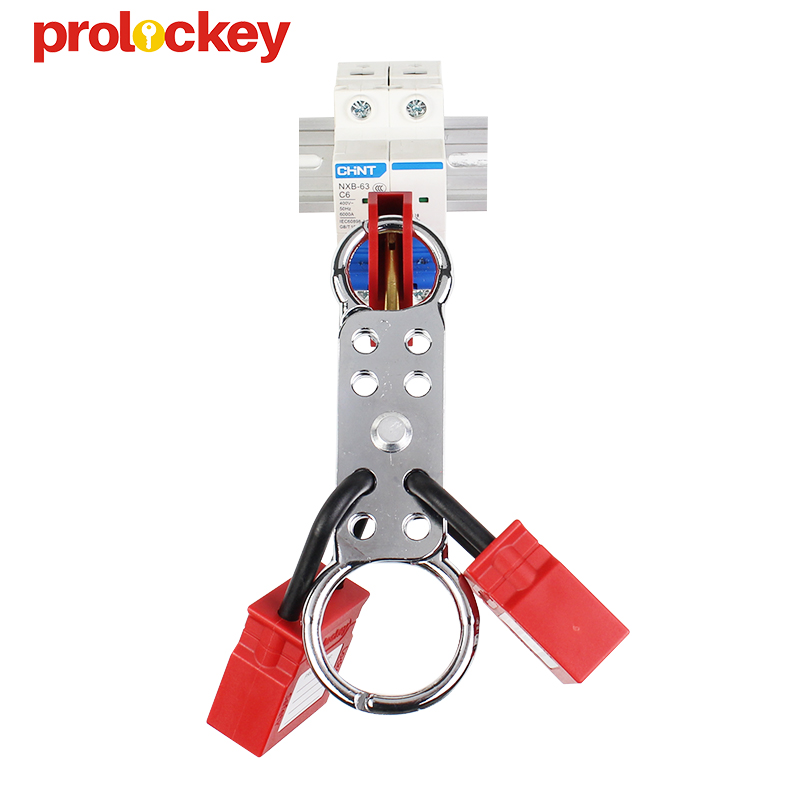
Remove each lock one by one from the Hasp or Lockbox.
Only when the last lock is removed can the isolation device be operated.

 Address: Tangxia Industrial Park, North Baixiang Town, Yueqing, Zhejiang, China
 Name: Miya
 Tel: 0086-577-62968730
 Fax: 0086-577-62531320
 E-mail:
  Skype:
  QQ:
QQ: