
In the field of industrial safety, LOTO (Lockout/Tagout) is a crucial safety measure to prevent accidents caused by unexpected
equipment startup. It serves as the last line of defense for
safeguarding personnel lives. As the physical "gatekeeper" of this
defense line - industrial safety locks - the choice of lock body
material is no trivial matter. It directly determines whether the lock
can remain in its position in harsh environments such as moisture,
corrosion, and high voltage, truly achieving "locked = safe". The
material of the lock body not only determines the durability of the lock
in specific environments but also affects its warning effect, safety
protection performance, and operational convenience.
Is
the lock body material the cornerstone of industrial safety locks? The
lock body is the main part that bears external forces and resists
environmental erosion. Inferior materials can cause the lock to rust,
break, and lose insulation, rendering the safety procedure ineffective.
Excellent materials must simultaneously meet four standards: high
strength, environmental resistance, insulation, and durability.
Full analysis of mainstream industrial safety lock materials: 1. Conventional metal locks: Such as imitation copper locks, imitation stainless steel locks, iron
locks, suitable for ordinary industrial environments without specific
requirements. The advantage is low price, but the disadvantages are also
significant. The basic surface coating process of these locks is prone
to rust after wear and is also very inconvenient to manage.
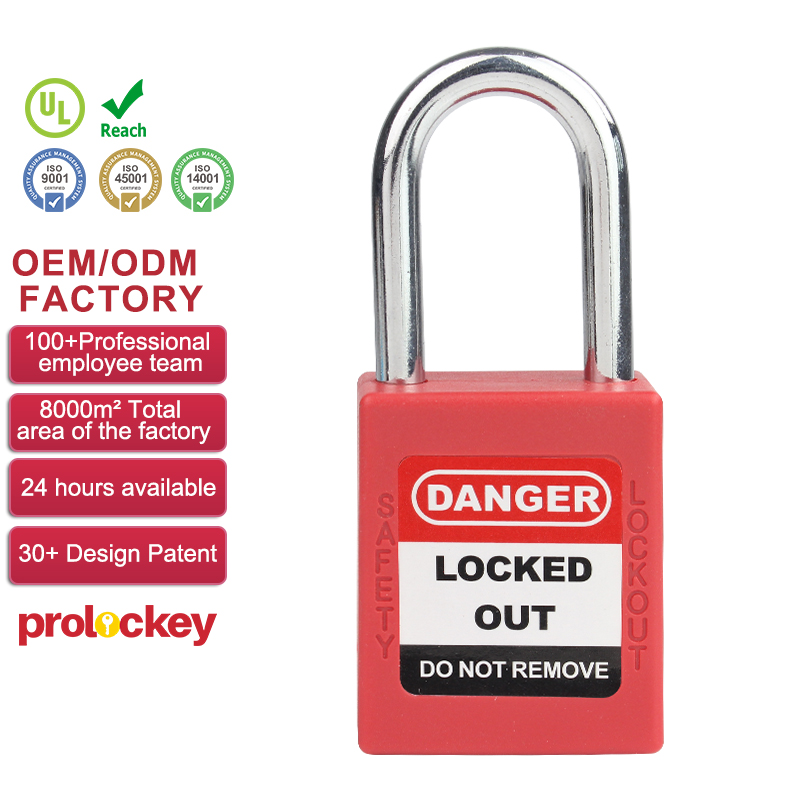
2. Engineering plastic locks: The guardian of insulation safety.
This
type of plastic lock has the characteristics of insulation,
anti-magnetic, corrosion resistance, and explosion-proof. It is a
mandatory requirement for electrical maintenance and power systems. This
material is designed through structural strengthening, maintaining
top-level insulation performance while optimizing its impact resistance,
corrosion resistance, and fatigue resistance, capable of coping with
harsh industrial environments; at the same time, the customization cycle
is short and convenient, facilitating management in the LOTO
(Lockout/Tagout) procedure.
3. Aluminum alloy locks: Lightweight
and with good corrosion resistance. Aluminum locks are lightweight,
easy to carry and manage, suitable for industrial scenarios with weight
sensitivity.
4. Stainless steel locks: Superior to other material locks in terms of strength and corrosion
resistance. The disadvantage is that the customization cost is high, the
customization cycle is long, the lock is heavy, and it is inconvenient
to carry multiple locks.
No matter what material it is, safety locks must meet the following core standards:
1. Unique key or non-interchangeable: Each lock or its series should have a unique key or combination to ensure that only the person who locks it can open it.
2. Customizable with standardized design: It should be easy to hang warning tags and have prominent colors and
markings (often color-coded by department, job type, or energy type).
3. Compliance: Compliant with the "Locking/Labeling for Hazard Energy Control Methods in Mechanical Safety" standard of GB/T 33579-2017.

 Address: Tangxia Industrial Park, North Baixiang Town, Yueqing, Zhejiang, China
 Name: Miya
 Tel: 0086-577-62968730
 Fax: 0086-577-62531320
 E-mail:
  Skype:
  QQ:
QQ: