
Industrial Safety Lock Body Color Selection and Its Core Function
In the field of industrial safety, the LOTO (Lockout-Tagout) procedure is the core defense line for isolating dangerous energy and
preventing accidental release. The color of the lock body of a safety
lock is far more than just a simple visual distinction; it is a highly
standardized visual safety language directly related to job safety,
responsibility implementation, and risk control.
The core principle of color selection: Standardization and Consistency
In
industrial safety locks, the color selection is not arbitrary; it
follows a clear and internally unified color coding standard. Its core
principle is: 1. Enterprise/factory-defined standards: Currently, there is no unified mandatory color specification
internationally, but every enterprise implementing LOTO must establish
and enforce its own "Color Coding Management Procedure". 2. Clear meaning, understood by all: The meaning of each color must be understood by all relevant personnel
(including employees, contractors, and visitors) through safety
training. 3. Visually striking, easy to distinguish: The color must be clearly distinguishable in a complex industrial environment and is usually in high saturation colors.
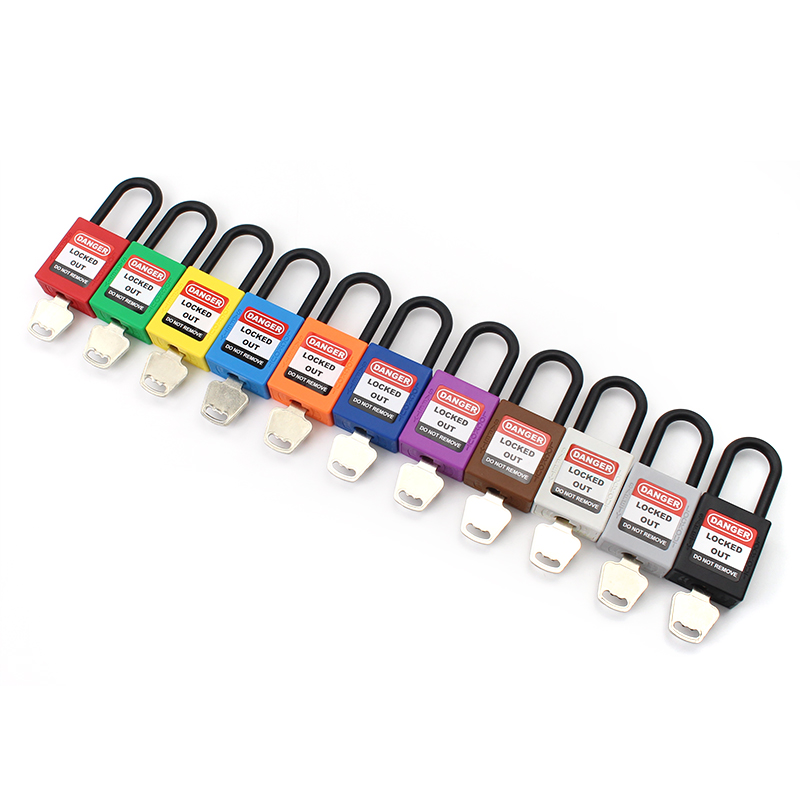
The five core functions of the lock body color:
1. Risk and Energy Type Identification: Clearly indicates the type of energy being isolated. For example:
Red:
General hazard symbol, or specifically for electrical energy. Yellow:
Warning, often referring to mechanical energy such as hydraulic or
pneumatic. Blue: Usually associated with air sources (compressed air,
oxygen) or water sources. Green: May represent low-voltage electricity
or a specific permitted system state. Core function: Enables workers to
be alert to the main types of risks from a distance.
2. Visualization of Personnel and Responsibilities: Achieve visual management of the principle of "one person, one lock, one key". The most common approach is:
By
department/group: The maintenance department uses blue, the production
department uses red, the contractor uses orange, and the cleaning team
uses green, etc. By individual: In small teams, assign a unique color to
each employee. Core function: In the scenario of collective locking
(group locking), it can quickly identify which personnel's lock has not
been removed, ensuring that the equipment cannot be started before all
personnel remove their isolation.
3. Work process and status management: Differentiate between work types and process stages. For example:
Maintenance
operations: Use red isolation lock. Regular maintenance: Use blue
isolation lock. Cleaning operations: Use green isolation lock. Testing
status: Other designated color locks or special tags may be used. Core
function: Helps coordinators or supervisors understand the current
operation status of the equipment, avoiding interference from concurrent
operations.
4. Enhance program compliance and management efficiency:
Facilitates on-site audits and inspections: Safety officers can
quickly determine whether the lockout operation complies with the
program (such as whether the contractor has used the correct color
lock). Simplifies training and memory: Converts complex program rules
into intuitive color memory points, reducing training costs and
minimizing human errors.
5. Strengthen safety communication and warnings:
Customization: Forms visual linkage with danger warning signs and
isolation point labels, constituting a "lock - sign - color" tripartite
warning system. Core function: In noisy and busy industrial
environments, colors provide the fastest and most direct silent warning,
reminding others "This equipment is under maintenance, do not operate!"
。

 Address: Tangxia Industrial Park, North Baixiang Town, Yueqing, Zhejiang, China
 Name: Miya
 Tel: 0086-577-62968730
 Fax: 0086-577-62531320
 E-mail:
  Skype:
  QQ:
QQ: