
Why can't the selection of locks be taken lightly?
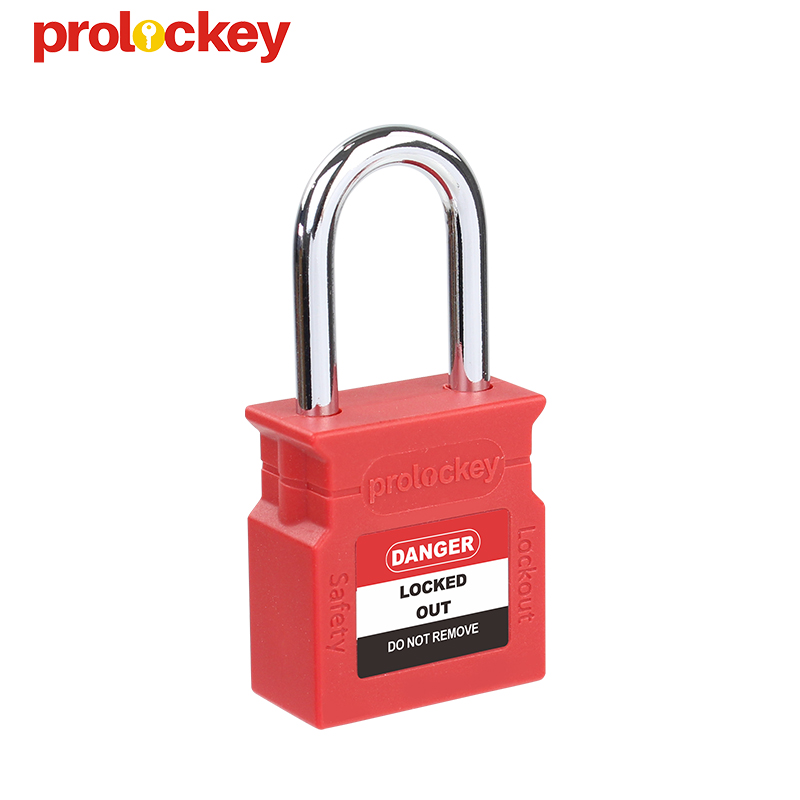
In the industrial LOTO (Lockout/Tagout) procedure, the safety lock is the last physical barrier for energy
isolation. When the equipment is powered off, the valves are closed, and
the pipelines are emptied - but what truly prevents someone from
mistakenly energizing or opening the valves is the lock hung at the
isolation point.
If this
lock falls off due to vibration, rusts in a corrosive environment, or
cannot fit when multiple people are locking simultaneously - then all
the written procedures, training records, and checklists will be
nullified.
The selection
of locks is not a procurement issue, but a safety issue. Here, we will
outline the core logic of selection from six dimensions.
II. The first step: Consider the environment, determine the material
The
material of the lock body is the first threshold for selection,
directly determining whether the lock can "survive" in a specific
environment.
Modified
nylon PA6 is the most commonly used insulating material, non-conductive,
corrosion-resistant, and lightweight, suitable for electrical
operations and humid environments. If workers need to climb or operate
in a distribution cabinet, the lightness and insulation of the nylon
lock are irreplaceable advantages.
Aluminum
alloy is the most versatile choice, lightweight, corrosion-resistant,
and cost-effective, suitable for most indoor industrial equipment and
general manufacturing scenarios. If your factory only buys one type of
lock, aluminum alloy is the safest starting point.
Stainless
steel 304 is specifically designed for harsh environments, with extreme
corrosion resistance and high temperature resistance, suitable for
chemical plants, offshore platforms, food and pharmaceutical industries,
etc. Here is a key detail to note: Many brands' "stainless steel locks"
only have stainless steel on the frame, while the lock body is still
galvanized steel - the true full stainless steel should be that both the
lock body and the frame are 304 stainless steel, with consistent
overall corrosion resistance.
Flame-retardant
aluminum is suitable for flammable and explosive environments, does not
produce sparks upon friction, is a must-have choice for oil fields,
chemical plants, and dust workshops, and usually requires ATEX
explosion-proof certification for legal use.
The selection principle is simple: First consider the environment and then select the material, not the other way around.
III. The second step: Look at the lock frame, determine the specification
The
lock frame is the part of the lock that passes through the isolation
point. If the specification is not selected correctly, the lock simply
cannot be hung.
The lock
frame materials generally have three types. Chrome-plated steel lock
frames have the highest strength, suitable for most mechanical isolation
points; nylon lock frames are insulated and will not scratch the
equipment surface, suitable for electrical operations; steel wire lock
frames are soft and can be bent, suitable for irregular-shaped isolation
points or narrow spaces.
The
diameter and height of the lock frame need to match the hole diameter
and spacing of the isolation point. If the diameter is too small, the
lock is prone to shaking and falling off; if the diameter is too large,
it cannot fit into the isolation hole. If the height is too short, the
lock cannot engage the lock catch; if the height is too long, it
occupies too much space and affects the operation of adjacent equipment.
A
practical tip: Measure the hole diameter of the isolation point, choose
a lock with a diameter 1-2 millimeters smaller than the hole diameter.
This ensures smooth insertion and avoids excessive shaking.
IV. The third step: Look at the key system, determine the management logic
The
key system is the most easily overlooked but most prone to problems in
the LOTO system. If one key can open multiple locks, the "one person,
one lock, one key" safety logic completely collapses.
KD
(Different Flowers) is the most basic solution - each lock is equipped
with an independent key, which are not interchangeable. This is the
standard configuration for individual locking, ensuring that each person
has only their own key to open.
KA
(Same Flowers) allows one key to open multiple locks, suitable for
scenarios where one person needs to manage multiple isolation points of
equipment, reducing the number of keys carried.
MK
(Secondary Management) adds a management master key on top of KA, where
the team leader can use the master key to open all subordinates' locks -
but note that the management of this master key must be extremely
strict, otherwise it will become a safety loophole.
GMK
(Third-level Management) is a multi-level key system, suitable for the
hierarchical management needs of large factories. The workshop director,
department manager, and safety director each hold different levels of
management keys.
No matter which system is chosen, there are two hard indicators that must be monitored:
First
is the inter-opening rate - the industry's excellent inter-opening rate
should be ≤ 1‰, meaning that out of 1,000 locks, at most 1 may be
opened by other keys. Locks with a rate lower than this pose serious
safety hazards in scenarios where multiple people are locking.
Second
is the key retention design - the key cannot be pulled out after being
inserted into the lock core; it must complete the locking action to
retrieve the key. This design physically eliminates the low-level
mistake of "the key is inserted but not locked, and the person leaves".
Five, the fourth step: Look at the color coding, determine visual management
Color
coding is not decoration; it is a standardized element explicitly
required by OSHA 1910.147(c)(5)(iii). Color enables workers to identify
"whose lock is this and what it represents" at a distance.
There
are two common color allocation logic schemes. By personnel identity is
the most commonly used scheme - maintenance team red, electrical team
blue, operators green, contractors yellow. Different personnel locking
results in distinct colors, and it is easy to identify when multiple
people lock. By energy type is another idea - electric red, hydraulic
yellow, pneumatic blue, mechanical orange. This is convenient for
quickly determining what kind of energy is isolated.
The
selection of color types should be within a certain range. Too few (1-2
types) will result in inability to distinguish different personnel's
locks when multiple people lock, and contractors' locks and employees'
locks will be confused; too many (more than 7 types) will cause
cognitive overload, and workers will not be able to remember what each
color represents. Industry practice shows that 3 to 7 colors are the
best range, which can meet the distinction requirements without
increasing the memory burden.
In
addition, color cannot be the only identification method. It must be
combined with laser-etched permanent identifiers - name, employee
number, department, number - even if the color fades, the text is still
readable. This is particularly important for locks used outdoors for
long-term use.
Six, the fifth step: Look at compliance certification, determine legal bottom line
The
LOTO safety lock is not an ordinary hardware item; it is a compliant
product involving life safety. When selecting, it is necessary to
confirm that the lock has met the requirements of relevant regulations
and standards.
In the US
market, OSHA 1910.147 is the core regulation, requiring the lock to meet
the "durable, sturdy, identifiable, standardized" four requirements
(abbreviated as DSID), and it must be used by the employer's designated
person. ANSI Z244.1 is a supplementary standard that provides more
detailed lock technical specifications.
In
China, GB/T 33579-2017 "Locking and Labeling for Energy Control
Methods" is an equivalent national standard, which has similar
requirements for the lock's firmness, unique identification, and
standardization as OSHA.
In
addition, if the factory has export projects or foreign customers, it
is also necessary to pay attention to the following certifications: CE
is the EU market access certification; ATEX is for use in explosive
environments; UL is for North American safety certification; REACH and
ROHS involve chemicals and hazardous substance restrictions, meeting
environmental compliance.
Selection
suggestions: Even if there is no current export demand, prioritize
choosing brands with complete certifications - complete certifications
mean a mature quality control system, and when expanding business in the
future, there is no need to replace the lock system.
Seven, the sixth step: Look at service support, determine long-term guarantee
Lock
purchase is not a one-time transaction, but a security system that
requires continuous maintenance. When selecting, in addition to looking
at the product itself, also look at the supplier's service capabilities.
Customization
ability is the first consideration. Factory equipment varies greatly,
and standard products may not cover all isolation points. An excellent
supplier should be able to provide a complete service chain from on-site
assessment, selection suggestions, scheme design to customized
production, rather than a simple transaction of "you place the order and
I deliver the goods".
The
warranty period directly reflects the brand's confidence in its own
products. The industry average warranty period is 1 year, while
excellent brands can offer 2 years or even longer warranties. Brands
with too short warranty periods (3 months or no warranty) have
questionable product quality control reliability.
Response
speed is crucial in emergency situations. When there is a quality
problem with the lock or a key is lost and needs to be urgently
replenished, whether the supplier can respond within 72 hours directly
affects the factory's downtime and the efficiency of safe recovery.
Training
support is often overlooked but is extremely important. Good suppliers
not only sell locks but also provide LOTO program training, selection
guidance and safety specification updates to help the factory
continuously improve the energy control system.

 Address: Tangxia Industrial Park, North Baixiang Town, Yueqing, Zhejiang, China
 Name: Miya
 Tel: 0086-577-62968730
 Fax: 0086-577-62531320
 E-mail:
  Skype:
  QQ:
QQ: