I. Common Hasp Hole‑Count Specifications
For
industrial‑grade safety hasps on the market, the number of locking
holes ranges from 4 to 24, with the mainstream specifications listed
below.
The
4‑hole hasp is the minimum size. It is intended for minor maintenance
or tasks with only a few personnel working on a single piece of
equipment. Compact and lightweight, it fits isolation points in confined
spaces.
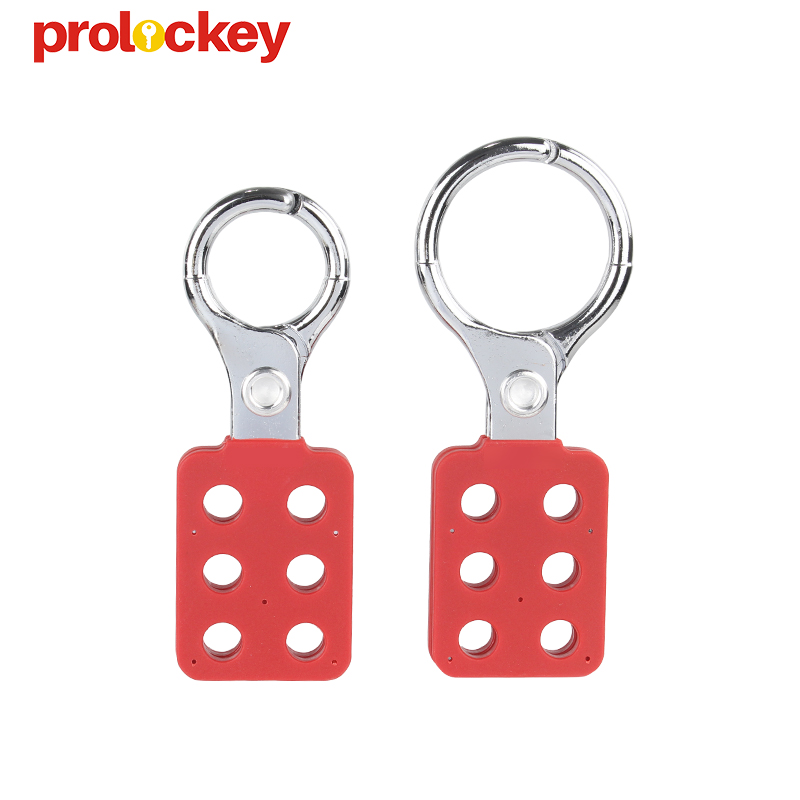
The
6‑hole hasp is the industry standard, covering most routine maintenance
scenarios. One mechanic, one electrician, one operator, one supervisor,
plus one or two spare positions — six holes are generally adequate.
The
12‑hole hasp is an extended‑capacity variant for multi‑person
collaborative major maintenance, such as annual production‑line
overhauls or cross‑trade joint work.
The
24‑hole hasp represents the common maximum size, designed for group
locking in system‑level isolation. When an entire production line or
plant unit is shut down for maintenance, every work team involved must
apply their lock at the same isolation point.
Scissor‑type
hasps are also available. They can be extended section‑by‑section to
increase the number of holes, delivering greater flexibility. Their
available specifications also cover 4 to 24 holes.
II. A Critical Rule More Important Than Maximum User Capacity
Once you understand hole‑to‑person matching, you must observe an inviolable principle within the LOTO (Lockout‑Tagout) system:
One Person, One Lock. Lock sharing is strictly prohibited.
This principle contains three core implications:
First,
two workers shall never share one lock. A lock comes with its unique
key. If shared, one worker could remove the lock without notifying the
other, leaving the second worker exposed to hazards while still
performing equipment work. Both OSHA 1910.147 and China GB/T 33579‑2017
explicitly require every authorized worker to apply their own personal
lock.
Second,
never fit two padlocks into a single hole. Each hole is dimensioned for
one padlock shackle only. Forcing two locks into one hole prevents full
lock closure and compromises locking integrity.
Third,
proxy locking is forbidden. Even trusted co‑workers or senior
supervisors must not place locks on behalf of others. A lock signifies:
“I am present; I do not authorize re‑energization.” A proxy lock offers
zero protection for absent personnel.
Accordingly,
the hole count of a hasp is not merely capacity. Each hole corresponds
to one individual worker, one exclusive key, and one independent safety
commitment.
III. More Personnel Than Holes — Three Valid Solutions
In
field practice, situations frequently arise: for example, twelve
personnel carry out maintenance, yet only six holes are available on the
installed hasp. No unauthorized work‑arounds are permitted. Three
compliant solutions are provided below.
Option
1: Add a secondary hasp. Mount a secondary hasp onto a hole of the
primary hasp, creating a hasp‑on‑hasp assembly. The primary hasp secures
the equipment isolation point, while the secondary hasp hangs from its
shackle to deliver combined hole capacity. Avoid excessive stacking;
generally no more than two layers, otherwise locking reliability will
degrade.
Option
2: Deploy a lock box. Where more than 12 personnel are involved, or
isolation points are scattered across multiple locations, group lock
boxes represent standard practice. Only one isolation lock is fitted at
the equipment isolation point; its key is placed inside the lock box.
All involved personnel apply their personal padlocks onto the lock box.
Lock boxes support far larger numbers of locks and handle large‑scale
maintenance with dozens of workers.
Option
3: Add additional isolation points. Excess personnel may stem from
multiple energy sources for one asset (electrical, pneumatic, hydraulic,
stored mechanical energy). Instead of cramming more locks onto one
single hasp, establish separate isolation points and hasps for each
energy source, so personnel apply locks at their respective points.
IV. Is It Risky to Have More Holes Than Personnel?
Conversely,
a 12‑hole hasp used by six workers poses no hazard. Vacant holes
provide no protection yet introduce no risk. Equipment can only be
re‑energized once every fitted lock has been removed. Every lock
represents one vote against re‑energization. Fewer locks mean fewer
opposing votes.
The
real hazard lies elsewhere: personnel assuming others have already
locked out on their behalf and failing to fit their own padlock. This
risk is highest during multi‑trade cross‑working. Individuals may think:
“So many locks are already in place; my lock does not matter.” On the
contrary, every padlock delivers independent protection. Without your
own lock, you remain unprotected behind other people’s judgements.
A widely‑used industry saying puts it plainly:
One extra lock causes no harm; one missing lock costs lives.


 Address: Tangxia Industrial Park, North Baixiang Town, Yueqing, Zhejiang, China
 Name: Miya
 Tel: 0086-577-62968730
 Fax: 0086-577-62531320
 E-mail:
  Skype:
  QQ:
QQ: