
The Role of Lockout‑Boxes in Group Lockout
For multi‑worker LOTO (Lockout‑Tagout) operations, when isolation points are scattered and many personnel are involved, attaching individual padlocks directly to every isolation point becomes inefficient and disorganised. The standard solution in this scenario is to deploy a Group Lock Box. Only one “isolation padlock” is fitted on the equipment’s energy‑isolation point, and the key to this lock is placed inside the group lock box. Every worker taking part in the job then secures their personal safety padlock onto the lock box.
In this workflow, the lock box acts as the key hub for the entire isolation system. As long as any personal padlock remains fastened to the box, the key to the isolation lock cannot be retrieved, and energy cannot be restored to the equipment. The key becomes accessible only once all workers have removed their individual locks.
Portable Group Lock Box: Mobile Lockout for Field Work
The design principle of a portable group lock box is: where the job goes, the lock box goes.
Typical features include a compact body, built‑in carry handle, capacity for 10‑40 personal padlocks, and a transparent or translucent polycarbonate shell, allowing instant visual inspection of the keys stored inside. Premium models are equipped with a key‑retention mechanism: once keys are placed inside and the box is locked, they cannot be removed until every padlock has been unlocked.
Suited for dispersed equipment and mobile maintenance crews. For example, a maintenance team may work in a pump house one day, a compressor zone the next, and a tank farm on the third. Before each task, the coordinator completes equipment isolation, places the isolation‑lock key inside the portable box, carries it to the work site, and each worker attaches their own padlock. When work finishes and all locks are removed, the box can be transported to the next job location.
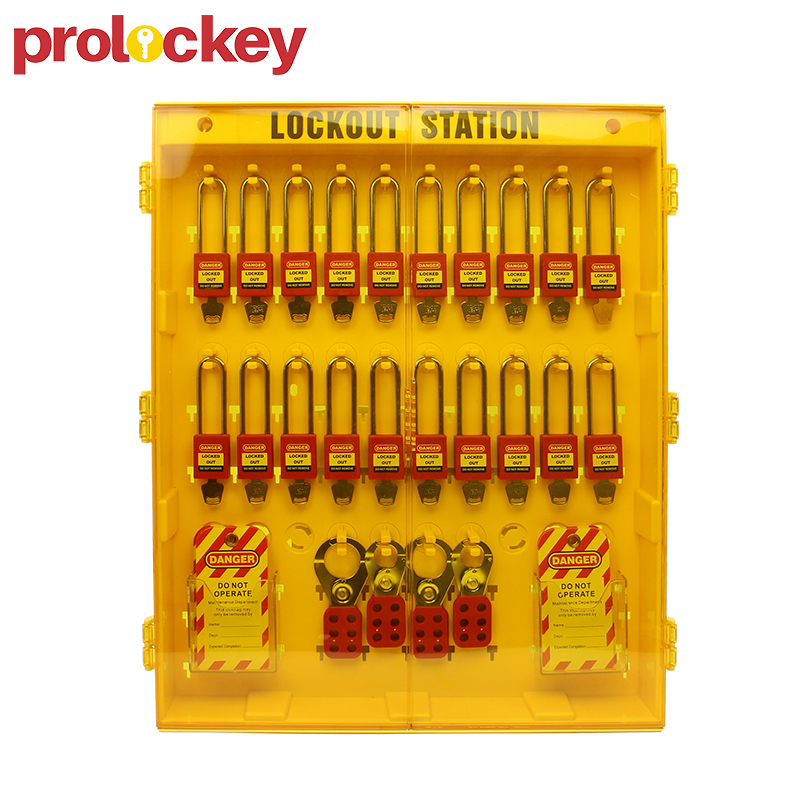
The design principle of a wall‑mounted group lock box is: the station stays fixed while workers come to the keys.
It is permanently or semi‑permanently installed on walls inside workshops, control rooms or electrical rooms. These boxes are normally larger‑sized, supporting between 12 and over 100 padlock positions. Housings are usually manufactured from steel or heavy‑duty engineering plastic; some versions include viewing windows and dedicated internal storage compartments for safety padlocks. Two common applications:
Ideal Workflow
Best‑suited for fixed equipment and recurring maintenance routines. For instance, a chemical‑plant reaction workshop carrying out scheduled monthly overhauls, with a consistent set of valves and circuit breakers requiring isolation. A wall‑mounted lock box installed near the workshop entrance holds all isolation keys, and workers come to the station to apply their locks, creating a repeatable, standardised procedure.
Advantages of Wall‑Mounted Lock Boxes
Limitations
Four Decision‑Making Questions to Select the Right Lock‑Box Type
You can make a clear selection by answering the following four questions:

 Address: Tangxia Industrial Park, North Baixiang Town, Yueqing, Zhejiang, China
 Name: Miya
 Tel: 0086-577-62968730
 Fax: 0086-577-62531320
 E-mail:
  Skype:
  QQ:
QQ: