
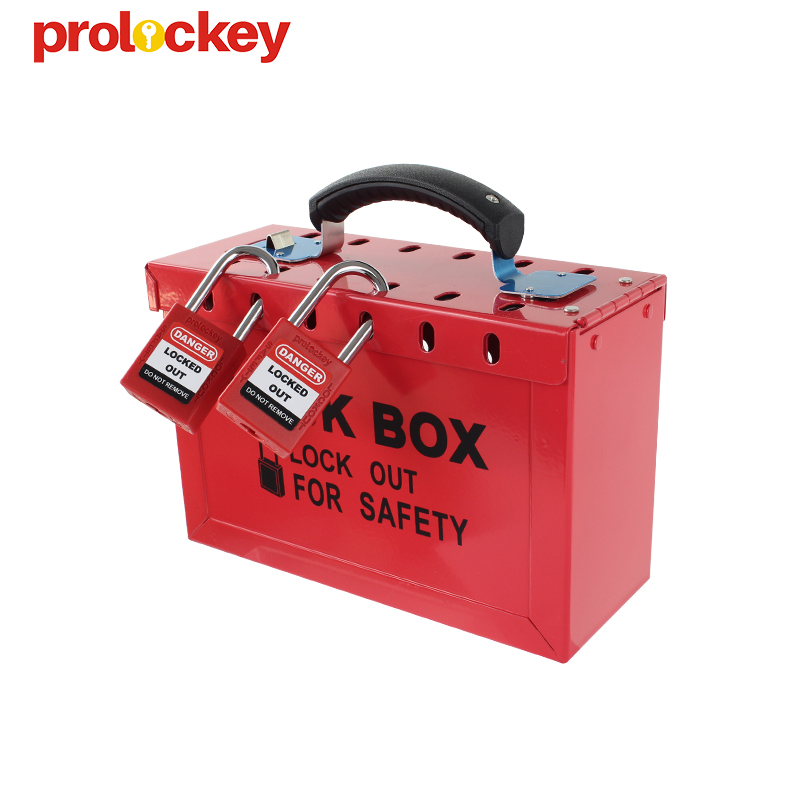
In group LOTO (Lockout-Tagout) operations, the group lock box (Group Lock Box) plays the role of the
"key center": only one isolation lock is hung at the energy isolation
point of the equipment, and the key of this lock is placed in the lock
box. All the workers involved in the operation then attach their own
personal locks to the box. As long as there is any personal lock hanging
on the box, the key of the isolation lock cannot be taken out, and the
energy cannot be restored.
Portable
and wall-mounted lock boxes are completely the same in this regard -
they are both physical carriers of the safety mechanism "energy can only
be restored with unanimous consent".
The
real difference lies in how they integrate into your workflow. The
following breaks down the differences between these two forms from five
dimensions.
Difference One: Installation Method - Mobile vs. Fixed
This is the most intuitive and also the one that affects everything.
The
wall-mounted lock box is "fixed" in place. It is secured to the wall of
the workshop, control room, or power distribution room with screws, and
it rarely moves after installation. Its presence itself is a commitment
- "This is the key center for this area, all isolation keys are managed
here". Workers do not need to look for it because it is always there.
The
portable lock box is "attached to the leg". It has a handle and is
designed to be carried around. The box is moved to the location where
the operation is carried out; when the task is completed, the box
follows the team. Its existence mode is "I am on site", not "I am on the
wall".
This difference
seems to be just the installation form, but it actually determines all
the subsequent differences: location determines who can use it
conveniently, how large the capacity can be, how high the risk of loss
is, and how the management responsibility is distributed.
Difference Two: Capacity Scale - Difference of Several Dozen Locks
The
wall-mounted lock box has an absolute advantage in capacity. Because it
is fixed to the wall, it is not restricted by transportation, and the
box can be made very large. Common specifications start from 12 lock
positions, and large ones can accommodate dozens or even hundreds of
personal locks, and can also manage multiple isolation points and the
isolation keys of multiple teams. During the annual major overhaul of
large equipment, a wall of lock boxes may hold the keys for the entire
system.
The portable lock
box is inherently limited. A box that needs to be carried away by one
hand has a volume and weight limit. Common specifications can
accommodate 10 to 40 personal locks, which is fine for small-scale
maintenance tasks, but when facing large teams of dozens of people and
large-scale operations with multiple isolation points, it will be
inadequate - either add more boxes or switch to wall-mounted.
In a nutshell: Wall-mounted is a warehouse, and portable is a backpack.
Difference Three: Visibility and Status Management
The
portable lock box usually uses transparent or semi-transparent boxes
(mostly polycarbonate material), which is a deliberate design: Workers
can see the status of the isolation lock keys through the box - if the
key is still there, the isolation is still in place; combined with the
row of personal locks hanging outside the box, it is immediately clear
"Who hasn't completed the task". The transparent box itself is a
continuous safety reminder.
The
wall-mounted lock box relies more on "institutionalized visibility".
The box is mostly made of steel or opaque engineering plastic, and it
cannot be seen inside, but because it is fixed in place, the manager can
establish a fixed identification system beside the box: isolation point
list, work permit number, nameplate of the person locking, key
registration form. Status management is not through "seeing in", but
through "posting out and recording".
Each
logic has its own strengths: Portable is good at being immediate and
intuitive, while Wall-mounted is good at being standardized and
traceable. In places with high safety requirements, they often rely more
on the latter's management method that has records and traceability.

 Address: Tangxia Industrial Park, North Baixiang Town, Yueqing, Zhejiang, China
 Name: Miya
 Tel: 0086-577-62968730
 Fax: 0086-577-62531320
 E-mail:
  Skype:
  QQ:
QQ: