
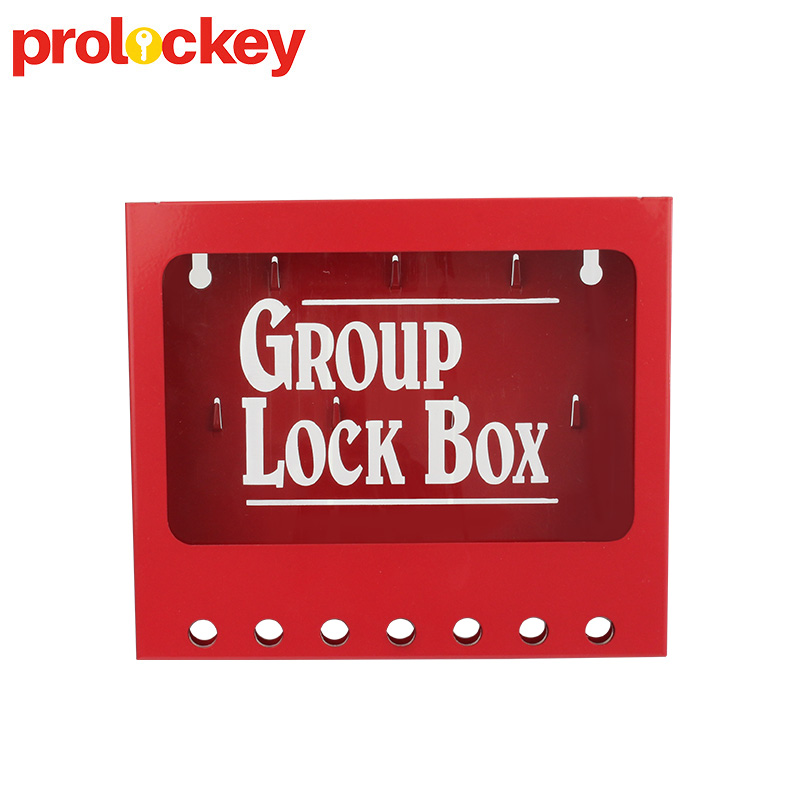
In the fields of industrial production and equipment maintenance, Group LOTO (Collective Lockout/Tagout) is a set of energy isolation control methods for scenarios involving "multiple people, cross-shifts, cross-trade skills, and long-term operations". It is an upgraded version of the traditional individual LOTO (Lockout/Tagout) in complex operation organizational forms: when multiple operators need to enter the dangerous area simultaneously, work at different positions, or the operation duration spans multiple shifts, relying solely on individual locking is often insufficient to ensure that "each person can independently control their own safety". The core function of Group LOTO is to transform energy isolation from a "single-person action" into "systematic team control", ensuring that the equipment cannot be mistakenly started or energy released accidentally before all personnel have evacuated and confirmed safety. 1. Key issues solved by Group LOTO: "Control authority" and "traceability" in multi-person operations In maintenance, cleaning, mold replacement, pipeline renovation, confined space entry, interlock testing and other operations, there are usually the following risks: large number of personnel, many locking points: A system may involve multiple energy sources such as electricity, gas, hydraulic pressure, steam, gravitational potential energy, etc., and needs to be locked at multiple isolation points; multiple trade skills, complex responsibility boundaries: Maintenance, electrical instrumentation, process, and external cooperation are all working simultaneously, who confirms the completeness of isolation? Who controls the unlocking? Long operation time, cross-shifts: The day shift is not completed and the night shift continues; if the handover is not standardized, there is a high risk of "someone is still inside, but the equipment has been reset". Group LOTO clarifies the control authority through "Group Lock Box/Group Board + unified isolation list + handover process": The isolation points are uniformly implemented and verified by authorized personnel, and the operators lock the lock box (or lock board) with their own personal locks. Without unlocking, the system cannot restore the energy. This ensures that "everyone has the veto power", preventing accidental power supply, valve opening, and switch closing. 2. Core functions of Group LOTO 1: Transform energy isolation from "point" to "system" The common practice of individual LOTO is: someone goes to a certain isolation point to Lockout/Tagout and confirms that it cannot be started. However, in complex systems, danger often comes from "system-level interconnection": You isolate the power supply, but you haven't isolated the gas source; you close the valve, but you haven't released the residual pressure; you disconnect the equipment, but you ignore the upstream interlock or bypass circuit. Group LOTO emphasizes isolation from a "system perspective", usually including: identification and listing of isolation points (which switches, circuit breakers, valves, interlock circuits, mechanical clamps, blind plates, etc.); implementation and verification of isolation (Lockout/Tagout/locking mechanical locks, releasing pressure, test startup verification, zero energy confirmation); centralized management and visualization (put isolation keys in the lock box, display isolation status, operation range, responsible person, and time on the lock board). Its value is to make energy isolation no longer rely on personal experience, but to form a replicable and auditable "system engineering" through lists, verification, and visualization. 3. Core functions of Group LOTO 2: Ensure "the equipment will not be reset until the last person leaves" One of the greatest dangers in multi-person operations is "thinking everyone has evacuated". Group LOTO uses a very simple but highly effective logic to ensure safety: Each operator must hang their personal lock on the lock box/lock board; only that person can remove their own lock (prohibiting others from unlocking on their behalf); when there is any personal lock on the lock box, the lock box cannot be opened, the isolation key cannot be taken out, and the energy cannot be restored. This means that the reset of the equipment is not based on verbal confirmation, roll call sheets, but on the "physical lock status". This is a "hard constraint" that minimizes the risks of human negligence, communication errors, and handover omissions.

 Address: Tangxia Industrial Park, North Baixiang Town, Yueqing, Zhejiang, China
 Name: Miya
 Tel: 0086-577-62968730
 Fax: 0086-577-62531320
 E-mail:
  Skype:
  QQ:
QQ: